
What a Trailer Brake Controller Does and Why Correct Setup Matters
If you tow a travel trailer, fifth-wheel, utility trailer, or cargo trailer with electric brakes, your trailer brake controller is one of the most important safety devices in the cab. It’s also one of the most misunderstood. Many towing problems that feel like “the trailer is pushing me” or “the trailer is yanking me” come down to a controller that isn’t matched to the trailer’s braking needs—or isn’t adjusted correctly for the load, road, and driving conditions.
This guide explains what a trailer brake controller does, the difference between proportional and time-delayed operation, what “gain” really means, and the common symptoms of poor adjustment. You’ll also learn why correct setup matters for stability, stopping distance, and brake wear—and when it’s time to have a pro check the system.
What a trailer brake controller actually does
Most modern trailers use electric trailer brakes (common on travel trailers and many utility/cargo trailers). Those brakes don’t apply themselves automatically when you press the truck’s brake pedal. Instead, the tow vehicle needs a controller to send a controlled amount of electrical power back to the trailer brakes.
In plain terms, a brake controller:
- Detects braking input from the tow vehicle (either through a sensor or a time-based output).
- Sends adjustable power to the trailer’s brake magnets so the trailer helps slow the whole combination.
- Allows fine-tuning (gain/output and sometimes “boost” or sensitivity) so the trailer brakes neither lag behind nor grab too hard.
- Provides manual control through a lever/slider so you can apply trailer brakes independently in certain situations (like correcting light sway or testing brake response at low speed).
When the controller is set correctly, the trailer contributes its share of braking smoothly. The tow vehicle stays more stable, you feel less “push” from the trailer, and you’re less likely to overheat or wear out brakes prematurely.
Proportional vs. time-delayed brake controllers (what’s the difference?)
Brake controllers generally fall into two categories. Both can work, but they behave differently—and that affects how they should feel on the road.
Proportional controllers
A proportional controller uses an internal sensor (often an accelerometer) to measure how hard the tow vehicle is decelerating. It then applies trailer brakes in proportion to that deceleration. Light braking at a stoplight gets light trailer braking. A harder stop gets stronger trailer braking.
What you’ll typically notice with a well-set proportional controller:
- Smoother stops with less “surge” feeling
- More consistent braking across different speeds
- Better control in traffic where braking varies constantly
Time-delayed controllers
A time-delayed controller applies trailer brake power based on a preset ramp-up. When you press the brake pedal, the controller starts at a chosen output and increases over a chosen time period until it reaches the maximum output you’ve set.
What you’ll typically notice with a time-delayed controller:
- It can feel a little “late” at the beginning of a stop if the ramp is slow
- It can feel grabby if the ramp is aggressive or the maximum output is too high
- It may require more frequent adjustment when load or road conditions change
Neither type is automatically “right” for every situation, but proportional controllers are often preferred for smoother, more natural braking—especially with heavier trailers or frequent towing.
What “gain” means (and why it matters)
Gain is the controller’s main adjustment. It’s essentially the maximum braking power the controller will send to the trailer brakes. Too low, and the trailer doesn’t help enough. Too high, and the trailer brakes can lock up or grab, which can destabilize the rig.
Gain is not a one-time “set it and forget it” number. It can change with:
- Trailer weight (empty vs. loaded)
- Road surface (dry pavement vs. wet or loose gravel)
- Speed and terrain (flat highway vs. rolling hills)
- Brake condition (newly adjusted brakes vs. worn components)
Some controllers also include settings like boost, sensitivity, or aggressiveness. These don’t replace gain—they change how quickly the controller reaches the gain level or how it responds to deceleration.
How to do a basic “sanity check” setup (without guessing)
Every controller brand is a little different, so always follow the controller’s manual. But here’s a practical, plain-language approach to confirm you’re in the ballpark.
Step 1: Start with a safe test area
Use an empty parking lot or a quiet road where you can do a few controlled stops. Make sure your trailer is properly hitched, safety chains are connected, and the breakaway cable is correctly attached.
Step 2: Confirm the controller “sees” the trailer
Most controllers display a connection indicator when the trailer is plugged in. If the controller doesn’t detect the trailer, don’t try to tune gain—there may be a wiring, connector, ground, or brake circuit issue. If you’re already troubleshooting trailer electrical issues, it can help to address related systems like trailer lights and wiring at the same time, since connection and grounding problems can show up across multiple circuits.
Step 3: Set a conservative gain and test manual braking
At a low speed (for example, around neighborhood speeds), use the manual lever/slider to apply the trailer brakes only. You’re looking for a firm, controlled braking response—without immediate lock-up or harsh grabbing.
If the trailer brakes feel weak or you barely feel them, increase gain gradually. If they lock up quickly or feel jerky, reduce gain.
Step 4: Test normal stops and watch for “push” or “pull”
Do a few normal stops using the brake pedal. A good setup usually feels like the trailer is helping, but not taking over. The tow vehicle should feel stable, and the trailer should track straight.
Remember: the goal isn’t to make the trailer do all the braking. The goal is a balanced stop where the trailer contributes appropriately for its weight.
Symptoms of poor brake controller adjustment (what it feels like)
Here are common real-world signs that the controller settings are off—or that there may be a mechanical/electrical problem in the trailer brake system.
1) The trailer feels like it’s pushing the truck during stops
This often points to gain too low or a controller that isn’t applying quickly enough. It can also happen if the trailer brakes are out of adjustment, contaminated, or not receiving full power due to wiring/ground issues.
2) The trailer brakes feel grabby or the trailer “tugs” backward
This can indicate gain too high or an overly aggressive boost/sensitivity setting. On some setups, it can also happen if one axle is braking harder than the other due to uneven adjustment or component wear.
3) Braking feels inconsistent from one stop to the next
Inconsistent braking can come from changing load, road conditions, or a controller that isn’t mounted/leveled as required (some proportional controllers are sensitive to mounting angle). It can also be a sign of intermittent electrical connection at the plug or a weak ground.
4) The trailer brakes lock up easily in wet conditions
Wet pavement reduces traction. If your gain is set near the limit on dry pavement, you may need to reduce it for rain. Lock-up can also indicate the trailer brakes are applying too aggressively for the available traction.
5) You smell hot brakes or notice unusual brake wear
Overly aggressive settings can cause the trailer brakes to work harder than necessary. On the flip side, settings that are too low can overload the tow vehicle brakes. Either way, heat and wear go up when the system isn’t balanced.
Why correct setup matters (beyond “it stops better”)
Correct brake controller setup isn’t just about comfort. It affects the entire towing system:
- Stability: Balanced braking helps keep the trailer tracking straight and reduces the chance of sway getting worse during braking.
- Control on descents: Proper trailer braking support can reduce how hard you have to ride the tow vehicle brakes on long grades.
- Emergency response: In a sudden stop, a well-tuned proportional response can help the trailer contribute quickly and predictably.
- Wear and heat management: Balanced braking helps avoid overheating either the tow vehicle brakes or the trailer brakes.
It also matters because towing setups change. A trailer that tows fine empty can behave very differently loaded for a trip. Even a change in cargo placement can affect how the trailer responds under braking.
Towing and braking are connected to your hitch setup
Your brake controller doesn’t operate in isolation. The way the trailer loads the hitch and the way weight is distributed can change how stable the rig feels under braking. If your trailer feels unsettled when you slow down—especially if you’ve recently changed trailers, added cargo, or upgraded your tow vehicle—it can be worth reviewing your hitch and towing hardware setup.
If you need help selecting or installing the right towing equipment, BlueBonnet can assist with trailer hitch installation so your towing setup matches the trailer’s needs.
Where the supporting image goes (what to look for in the cab)
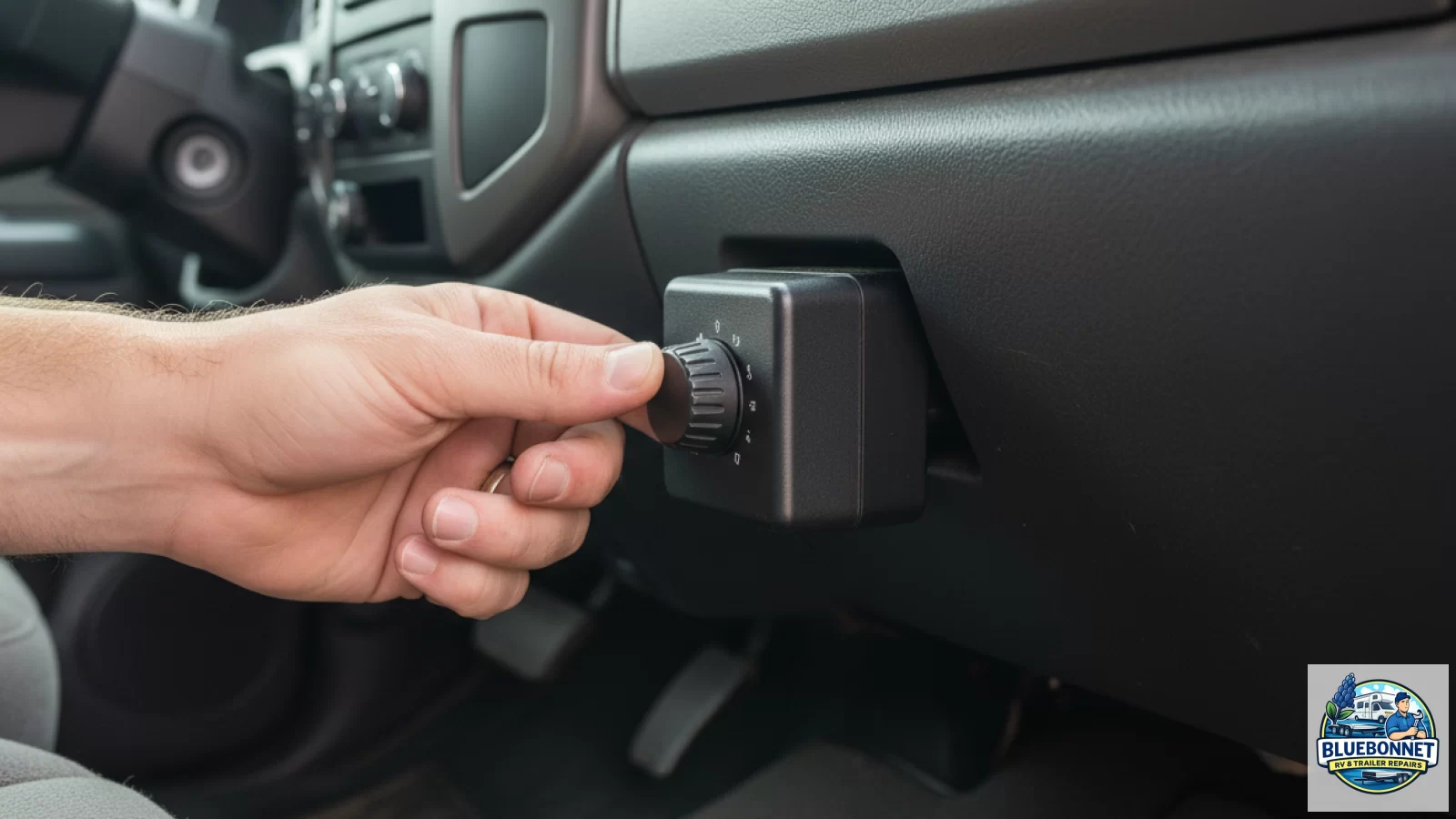
Most brake controllers are mounted within easy reach of the driver, typically under the dash near the steering column or center console. You should be able to access the manual lever/slider without taking your eyes off the road for long. If your controller is mounted awkwardly, loose, or hard to reach, it’s harder to make safe adjustments and harder to respond if you need manual trailer braking.
When to get the system checked (not just the settings)
If you’ve adjusted gain and sensitivity and the trailer still doesn’t brake consistently, it may not be a “settings” problem. Common underlying issues include:
- Corroded or loose trailer plug connections
- Poor grounding between tow vehicle and trailer
- Worn brake shoes/drums or out-of-adjustment brake assemblies
- Damaged wiring along the trailer frame
- Controller mounting angle issues (for some proportional models)
A proper inspection can confirm whether the controller is sending the right output and whether the trailer brakes are responding evenly across axles. That’s especially important if you’re preparing for a long trip or towing in heavier traffic.
Practical next step
If your trailer feels like it’s pushing you during stops, grabbing too hard, or braking inconsistently, don’t ignore it—those are fixable problems, and the right setup can make towing feel dramatically more controlled.
BlueBonnet RV & Trailer Repairs can help you verify your brake controller settings, check trailer brake response, and troubleshoot wiring or connection issues so your towing setup is safer and more predictable. Request service to schedule a check.