
When an RV furnace stops heating, the symptom can be as simple as “nothing happens” or as confusing as a blower that runs normally but never produces warm air. Other times, the furnace starts, shuts back down, or cycles repeatedly without getting the RV comfortable.
You do not need to diagnose the furnace before requesting service. In fact, the most useful information is usually what the system is doing, when it happens, and whether anything else in the RV’s power system changed at the same time.
BlueBonnet’s RV heater and furnace repair service covers common no-heat, ignition, airflow, cycling, thermostat, safety-switch and control problems. A few safe observations before the appointment can give the technician a much better starting point.
Start with the exact symptom
“The furnace is broken” can describe several different problems. Before calling, pay attention to which of these best matches what you are seeing:
- The thermostat calls for heat, but the furnace does nothing.
- The blower starts, but the air never becomes warm.
- The furnace appears to ignite, then shuts back down.
- The furnace starts and stops repeatedly in short cycles.
- Airflow is noticeably weaker than normal.
- The furnace works sometimes but not every time.
- The thermostat display is blank, resets, or behaves unusually.
That description is more useful than guessing which component failed. Furnaces depend on several systems working together, so similar symptoms can have different causes.
If the blower runs, note what happens next
One of the easiest things to observe safely is whether the blower starts after the thermostat calls for heat.
If the blower runs, listen for what happens next. Does the sound change as the furnace attempts to heat? Does warm air begin coming from the vents? Does the blower continue running with cold air? Does the system shut itself down after a short period?
A simple description such as “the blower runs for about a minute, but the air stays cold and then the furnace shuts off” is useful diagnostic information. You do not need to remove the furnace access panel or test components yourself.
If nothing happens at all, include the thermostat and power symptoms
An RV furnace is not only a heating appliance; its blower, thermostat and controls also depend on the RV’s electrical system. If the thermostat calls for heat and nothing happens, note whether other 12-volt equipment in the RV is behaving normally.
If lights are unusually dim, the thermostat is resetting, or other 12-volt equipment is acting differently, that may be worth mentioning when you request service. BlueBonnet’s RV battery and charging diagnostics and RV electrical repair services cover the power-side problems that can overlap with furnace symptoms.
Short cycling is worth documenting
A furnace that starts and stops repeatedly can be frustrating because it may appear to work for a few moments at a time. Instead of repeatedly changing thermostat settings, document the pattern.
Useful details include:
- How long the blower runs before the furnace shuts down
- Whether any warm air is produced before shutdown
- Whether the furnace restarts on its own
- Whether the problem happens every time or only occasionally
- Whether the problem started suddenly or became more frequent over time
If the system makes an unusual sound during the cycle, a short video recorded from a safe position can also help.
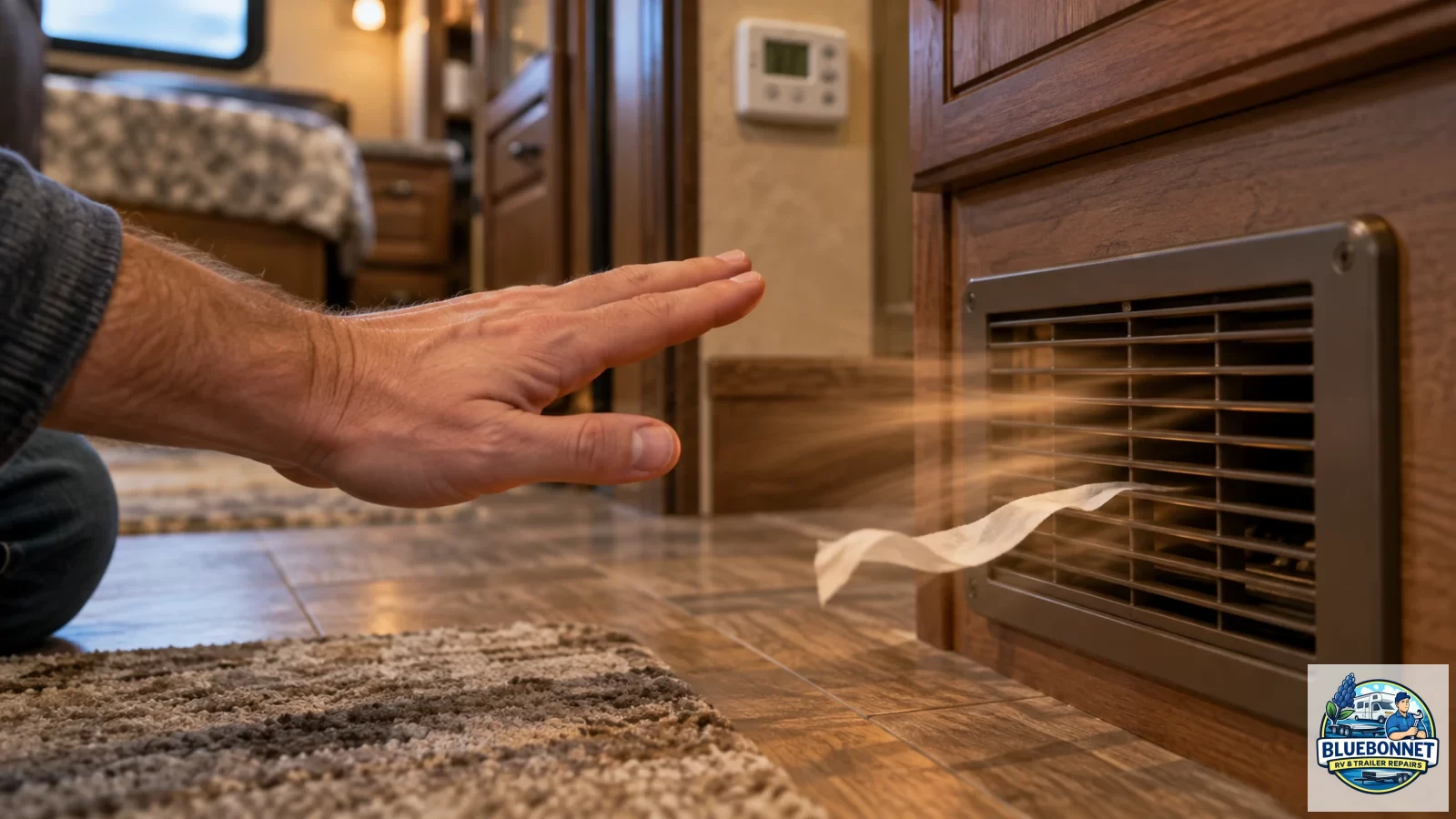
Weak airflow can point to a different problem than no heat
If the furnace is producing heat but airflow is weak, say that specifically. Weak airflow and no ignition are different symptoms.
Check only the things that are normally accessible to the RV owner. Make sure interior heat registers have not been accidentally closed or blocked by stored items, bedding, rugs or furniture. If the furnace return-air area is obviously obstructed, note that as well.
Do not remove safety covers, reach into the furnace compartment, bypass switches or operate the furnace with protective panels removed just to gather more information.
Tell us what changed before the problem started
Furnace problems are easier to narrow down when there is a clear timeline. Think about whether anything changed shortly before the symptom appeared.
For example, tell BlueBonnet if the RV recently:
- Sat unused for an extended period
- Changed campsites or power sources
- Had battery or charging-system problems
- Had electrical work performed
- Had another appliance or control issue appear at the same time
- Started showing a thermostat error or unusual display behavior
You do not need to know whether those events caused the furnace problem. They simply give the technician useful context.
Photos and video that can actually help
A handful of targeted photos is usually more useful than dozens of general RV pictures.
Consider sending:
- A clear photo of the thermostat while it is calling for heat
- A photo of any visible error message
- The RV year, make and model
- The furnace manufacturer/model information if it is safely accessible without disassembly
- A short video if the furnace repeatedly starts, stops or makes an unusual sound
If the furnace identification label is inside a service compartment that requires removing covers or reaching around electrical or fuel-system components, leave it alone. The technician can identify the equipment during service.
Do not bypass furnace safety systems
RV furnaces use safety controls for a reason. If the furnace will not stay running, do not bypass switches, jump wires, defeat safety devices or repeatedly force ignition attempts.
Likewise, do not open fuel-system components or make adjustments inside the burner area unless you are qualified to service that equipment. A no-heat problem is inconvenient, but turning it into an electrical, fuel or combustion safety problem is worse.
Mobile service or the Rice service center?
Many furnace diagnostics can be performed where the RV is located when access and site conditions allow. If the repair becomes more involved or protected workspace would make the job easier, BlueBonnet can also use the Rice service center.
The correct service location depends on the RV, the furnace setup and what the initial diagnosis shows. You do not need to decide that before requesting service.
What to send when requesting RV furnace repair
A useful service request can be short. Include:
- RV year, make and model
- Whether the blower runs
- Whether any warm air is produced
- Whether the furnace shuts down or short cycles
- Any thermostat error or unusual display behavior
- Any recent battery, charging or electrical symptoms
- A photo of the thermostat and any safely accessible equipment label
- Your current location and whether the RV can be moved
That gives the technician a useful starting point without asking you to diagnose or disassemble the furnace yourself.
Get the symptom documented before the next cold night
If your RV furnace is not heating, is short cycling, has weak airflow or will not respond to the thermostat, document what it is doing while the symptom is happening. Then request service or call (903) 804-6600 with the RV details and a few clear observations.