
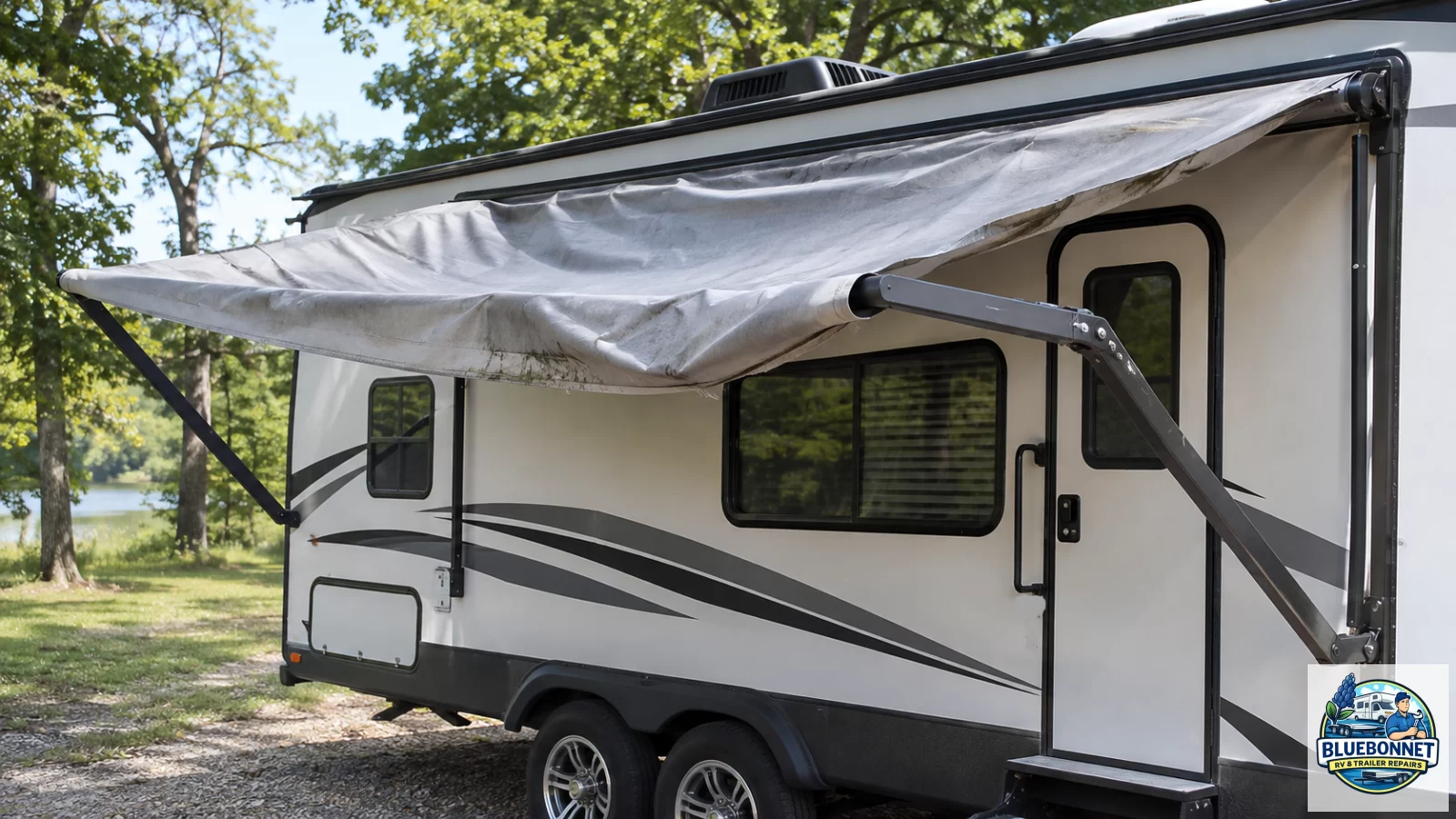
An RV awning can go from a convenient shade system to a problem surprisingly fast. Fabric can sag or tear. Arms can bind or sit unevenly. An electric awning may stop moving, move only partway, or refuse to retract. Mounting points can loosen, and a small alignment problem can turn into a larger one if the awning is repeatedly forced open or closed.
The important question is not simply whether the awning is “broken.” It is whether the damaged part can be repaired or adjusted safely, whether one component should be replaced, or whether enough of the system is damaged that a larger replacement makes more sense.
BlueBonnet’s RV awning repair service covers manual and electric awnings, including alignment, hardware issues, motors, arms, fabric tension and mounting points. The correct repair depends on what is actually damaged and how the awning behaves when inspected.
Some awning problems are adjustment or component problems
Not every awning problem means replacing the whole assembly. If the fabric is basically usable and the main structure is still sound, the repair may involve correcting alignment, addressing a binding arm, repairing or replacing a specific hardware component, or diagnosing an electric operating problem.
- The awning extends unevenly from one side to the other.
- One arm appears to move while the other side lags or binds.
- The fabric rolls off-center or develops unusual wrinkles.
- The awning stops before it is fully extended or retracted.
- An electric awning makes noise but does not move normally.
- The awning moves, but the arms or roller do not sit square when closed.
Awning manufacturers publish separate procedures for fabric centering, pitch-arm issues, motor replacement, support-arm replacement and fabric repair. That is a good reminder that many awning failures are component-specific rather than automatic whole-awning replacements.
Fabric damage does not always mean replacing the hardware
Awning fabric gets most of the visual attention because tears, holes, stretching and worn seams are easy to see. But the condition of the fabric and the condition of the hardware are two separate questions.
Small fabric problems may sometimes be repairable depending on their location and extent. Larger tears, severe weathering, stretched material or damage along important attachment areas may make fabric replacement the more practical direction.
If the arms, roller and mounting hardware are otherwise in good condition, replacing fabric does not automatically mean replacing the entire awning assembly. BlueBonnet can inspect the system and determine whether the damage is primarily fabric-related or whether other components have also been affected.
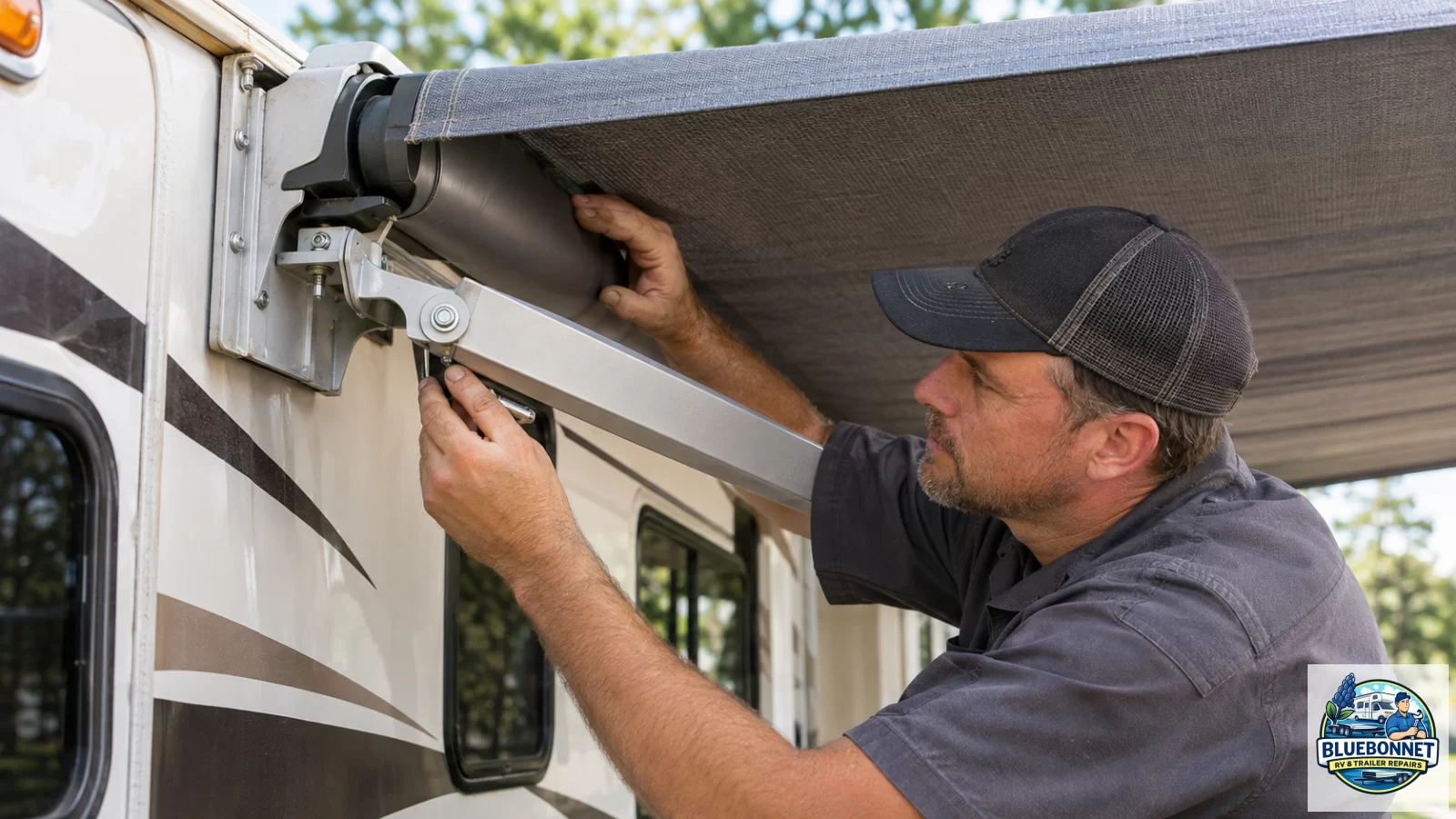
Bent, twisted, or damaged arms change the conversation
Awning arms carry and control the load of the extended awning. If an arm is visibly bent, twisted, pulling away from the RV, or no longer moving in the same path as the opposite side, stop forcing the awning to operate.
A damaged arm may be replaceable as an individual component on some systems. But if several structural parts are damaged at once, the roller is distorted, mounting points are compromised, or the awning no longer closes safely against the RV, the overall repair can become more involved.
This is especially important after wind damage. An awning that looks merely “crooked” may have stress in the arms, brackets, roller or attachment points. Continuing to cycle it can make the damage worse or leave the awning unable to secure for travel.
If an electric awning will not move, do not assume the motor is the only possibility
Electric awnings add another layer of diagnosis. A system that will not extend or retract can involve the motor, controls, wiring, power supply, fuse or other electrical components.
That is why a useful service request should describe exactly what happens when the switch or control is used. Does nothing happen? Is there a click or motor sound? Does the awning move a few inches and stop? Does it work intermittently?
If the awning problem appears alongside other 12-volt symptoms in the RV, BlueBonnet’s RV electrical repair service may also be relevant. The goal is to test the actual system rather than replace a motor based only on a guess.
Mounting-point damage can make a small-looking problem more serious
Pay close attention to where the awning arms and brackets attach to the RV. If a bracket has pulled away, fasteners appear loose, the wall surface is flexing, or there is visible separation around a mounting point, do not keep operating the awning.
The awning hardware can only work correctly if it is securely attached. A damaged mounting area may require more than an awning adjustment because the underlying attachment point has to be evaluated before the awning is safely operated again.
This is one of the situations where photos help. Send a wide photo showing the entire awning and a closer photo of the questionable mounting area without trying to tighten or disassemble it first.
When replacement starts to make more sense
Replacement becomes more reasonable when damage is spread across several major parts instead of being isolated to one repairable component.
- Severely deteriorated or extensively torn fabric combined with worn hardware
- Multiple damaged or distorted arm components
- A roller assembly that is no longer straight or operating correctly
- Repeated failures across an older system where several components would need replacement
- Damage that prevents the awning from closing and securing properly for travel
That does not mean every ugly awning needs to be replaced. Sometimes a fabric replacement and adjustment is the sensible answer. Sometimes one arm, motor or hardware component solves the problem. Other times the amount of combined damage makes a larger replacement the cleaner repair path.
Do not force a damaged awning closed
If an awning is badly twisted, binding, partially detached or mechanically jammed, repeatedly holding the switch or pulling harder on the system can create additional damage. Awning hardware can also move unexpectedly under stored tension.
If you are not sure the awning can be secured safely for travel, stop operating it and request service rather than improvising around springs, arms or electrical connections.
What to send before scheduling RV awning repair
- RV year, make and model
- Whether the awning is manual or electric
- Whether it currently extends and retracts
- Whether the problem affects the fabric, arms, roller, motor or mounting area
- A wide photo showing the entire awning
- Close-up photos of visible tears, bent hardware or loose mounting points
- A short video if the awning moves unevenly, binds or stops during operation
- Your location and whether the RV can be moved safely
If the awning is partially open and cannot be secured, say that immediately when requesting service. That changes the priority from a normal convenience repair to making sure the RV can be secured safely.
Repair the damaged part—or replace the system that no longer makes sense to repair
The best RV awning repair is not automatically the smallest repair or the biggest replacement. It is the option that addresses the actual damage and leaves the awning operating and securing correctly.
If your awning is torn, sagging, binding, crooked, not retracting or damaged after wind or impact, request service or call (903) 804-6600. Send a few clear photos and a description of what the awning does when you try to operate it, and BlueBonnet can start with the right inspection path.