
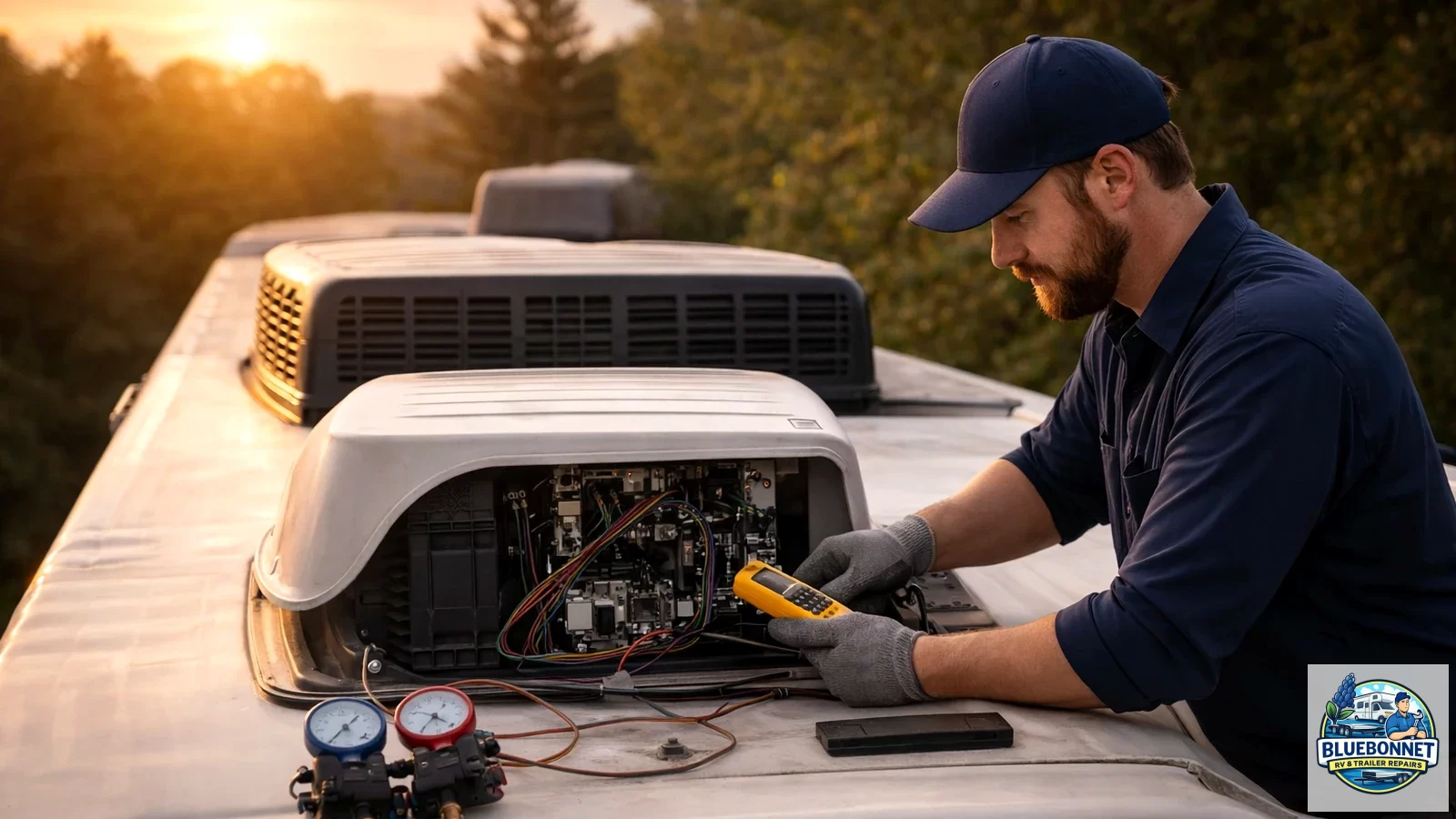
When an RV air conditioner struggles in Texas heat, “the A/C isn’t working” can describe several very different problems. The unit may run but blow warm air. It may cool for a while and then stop. Airflow may be weak even though the compressor sounds normal. The thermostat may call for cooling but nothing happens. Or the problem may be tied to the RV’s power supply rather than the rooftop unit itself.
You do not need to diagnose the A/C before calling for service. A few clear observations can make the first conversation much more useful and help a technician decide what needs to be checked first.
Start with what the A/C is actually doing
The most useful description is the symptom you can observe, not the part you think failed. BlueBonnet’s RV air conditioner repair service covers problems such as weak airflow, no cooling, thermostat faults, fan issues, control problems and power-supply faults. Those symptoms can overlap, so describing the behavior matters.
Before the appointment, note which of these best matches what you are seeing:
- The A/C turns on and moves air, but the air never feels noticeably cooler.
- The unit starts cooling, then stops or begins cycling unusually.
- The fan runs, but airflow from the ceiling vents is weak.
- The thermostat is calling for cooling, but the rooftop unit does not start.
- The unit makes an unusual noise or attempts to start but does not stay running.
- A breaker trips or the problem appears only on certain power sources.
- One A/C works while another unit on the same RV does not.
That kind of description is more useful than saying, for example, “the capacitor is bad” unless the component has already been tested.
Tell us whether the fan, compressor, or neither seems to run
You do not need to climb on the roof or open the A/C shroud to gather useful information. From inside the RV, listen to what happens after the thermostat is set to cool. Does the indoor fan start? Do you hear the rooftop unit change sound shortly afterward? Does it attempt to start repeatedly? Does the airflow stay steady?
A simple timeline can help: “The fan starts immediately, the unit gets louder about 20 seconds later, but the air never gets cold,” or “It cools normally for 15 minutes and then shuts down.” Exact technical terminology is not necessary.
Check the thermostat settings before assuming the rooftop unit failed
Thermostat and control issues are part of normal A/C diagnostics. Confirm that the thermostat is in cooling mode, the temperature setting is below the current interior temperature, and the fan setting is where you expect it to be.
If the thermostat display is blank, intermittently resets, shows an error, or behaves differently from normal, include that in the service request. A photo of the thermostat display can be more useful than trying to describe every symbol over the phone.
Power-source details matter
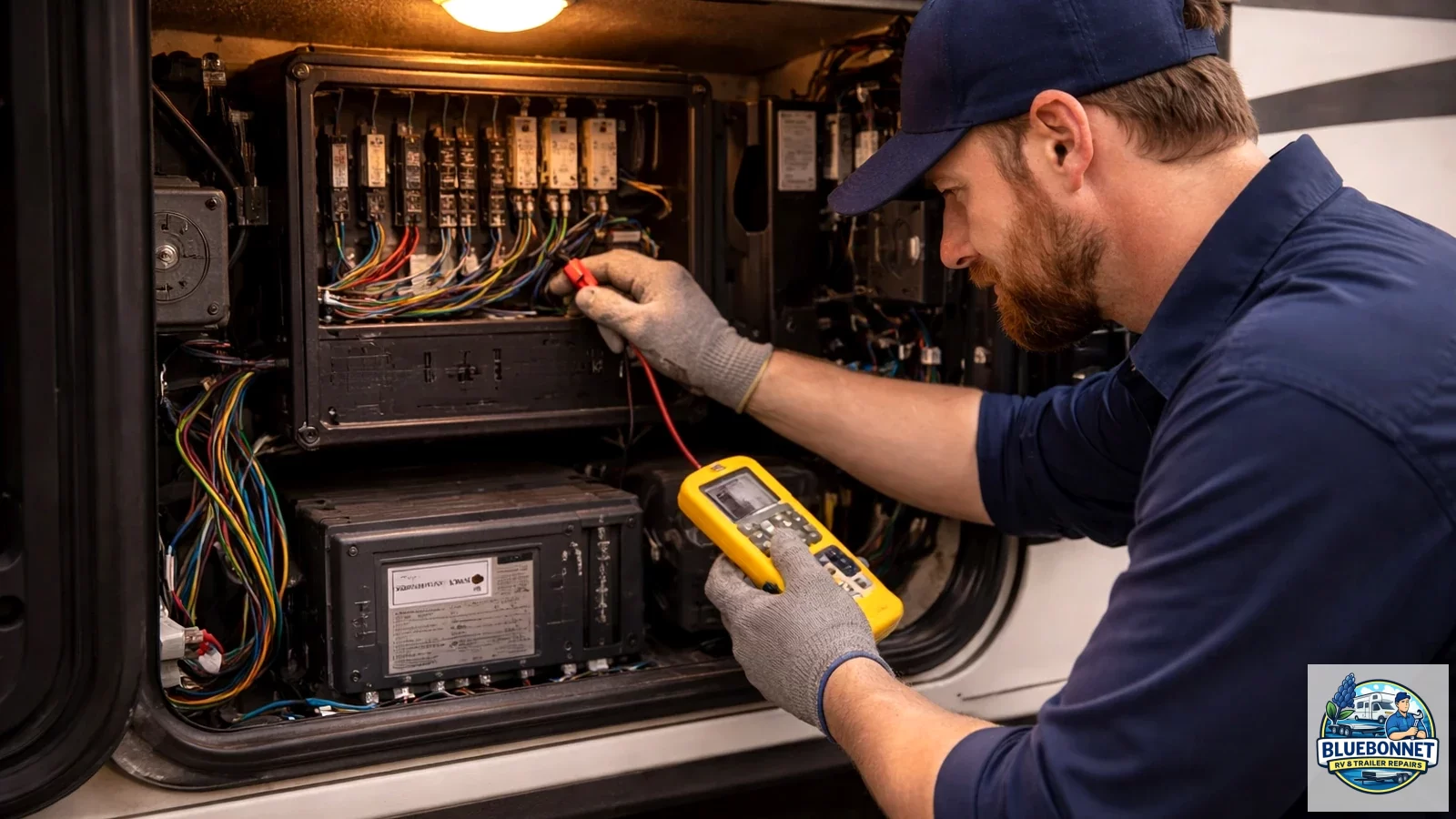
RV A/C problems are not always isolated to the rooftop assembly. BlueBonnet also handles RV electrical and wiring diagnostics, including 12V and 120V power issues, breakers, shore-power faults, converters and wiring concerns.
Tell us what the RV is connected to when the problem occurs:
- Campground or home shore power
- Generator
- A different pedestal or outlet than usual
- An adapter or extension arrangement
If the A/C behaves differently on generator power than it does on shore power, that is useful diagnostic information. The same is true if a breaker trips, lights dim, other appliances act differently, or the issue began after a power interruption.
Do not open electrical panels or bypass breakers just to gather more information. Report what you can safely observe.
Weak airflow is different from warm airflow
“Not cooling” can mean the air is warm, or it can mean there is not enough air moving through the RV. Those are different symptoms.
If the airflow feels weak, note whether it is weak at every ceiling vent or only certain vents. If your RV has directional vents, make sure they are open and positioned normally. If an accessible return-air filter is visibly dirty, that is worth noting as well.
You do not need to remove rooftop covers, probe electrical components or disassemble the interior air box before service. A technician can inspect the system safely and determine whether the problem is related to airflow, controls, power or the A/C unit itself.
When does the problem happen?
Texas weather can make patterns easier to notice. An A/C that seems normal early in the day but struggles later in hotter conditions gives the technician different information than a unit that never cools at all.
Useful details include:
- Approximate outside conditions when the problem is worst
- Whether the issue happens immediately or only after the unit has been running
- Whether the problem occurs every time or intermittently
- Whether it started suddenly or became worse over time
- Whether the RV recently changed locations or power sources
You do not need to prove the exact cause. The goal is to identify the pattern.
Send the A/C model information if it is easy to access
If you can safely find the manufacturer and model number without removing equipment or climbing onto the roof, send a clear photo of the label. Also send the RV year, make and model and whether it has one rooftop A/C or multiple units.
That information can help identify the type of system before the appointment. If the label is not safely accessible, do not climb on the roof just to get it.
Photos and a short video can help
A few targeted photos are usually more useful than a large batch of unrelated pictures. Consider sending:
- The thermostat display while the problem is occurring
- The interior ceiling assembly and return-air area
- The RV’s exterior showing which rooftop A/C is affected if there are multiple units
- Any visible error code or breaker position
If the unit makes a strange start-up noise or repeatedly attempts to start, a short video from a safe position inside the RV can also help document what you are hearing.
What not to do before the appointment
Some A/C problems involve electrical components and rooftop equipment. Unless you are qualified and equipped to work on those systems, avoid opening electrical compartments, touching capacitors, bypassing protection devices or climbing onto an unsafe roof.
It is enough to document the symptom and leave the testing to the service visit.
Mobile service or the Rice service center?
Many A/C diagnostics can be handled where the RV is located when access, power and site conditions allow. BlueBonnet can also use the Rice RV Service Center when the job is better suited to protected shop space or additional repair work.
The right location depends on the RV, the symptoms and the conditions around the unit. If the Rice shop is being considered, call before arrival so BlueBonnet can confirm current intake and access.
What to send when you request service
A useful A/C service request can be short. Include:
- RV year, make and model
- How many A/C units the RV has and which one is affected
- Whether the fan runs
- Whether the unit ever produces cool air
- Whether the problem is constant or intermittent
- What power source the RV is using
- Any breaker trips, thermostat errors or unusual sounds
- Photos of the thermostat and interior A/C assembly
- Your location and whether the RV can be moved
That gives BlueBonnet a much better starting point than “my A/C stopped working” while still leaving the actual diagnosis to the technician.
Get the symptom documented before the next hot day
If your RV A/C is blowing warm air, losing airflow, cycling strangely or refusing to start, document what it is doing while the symptom is happening. Then request service or call (903) 804-6600 with the RV details, power source and a few clear photos.